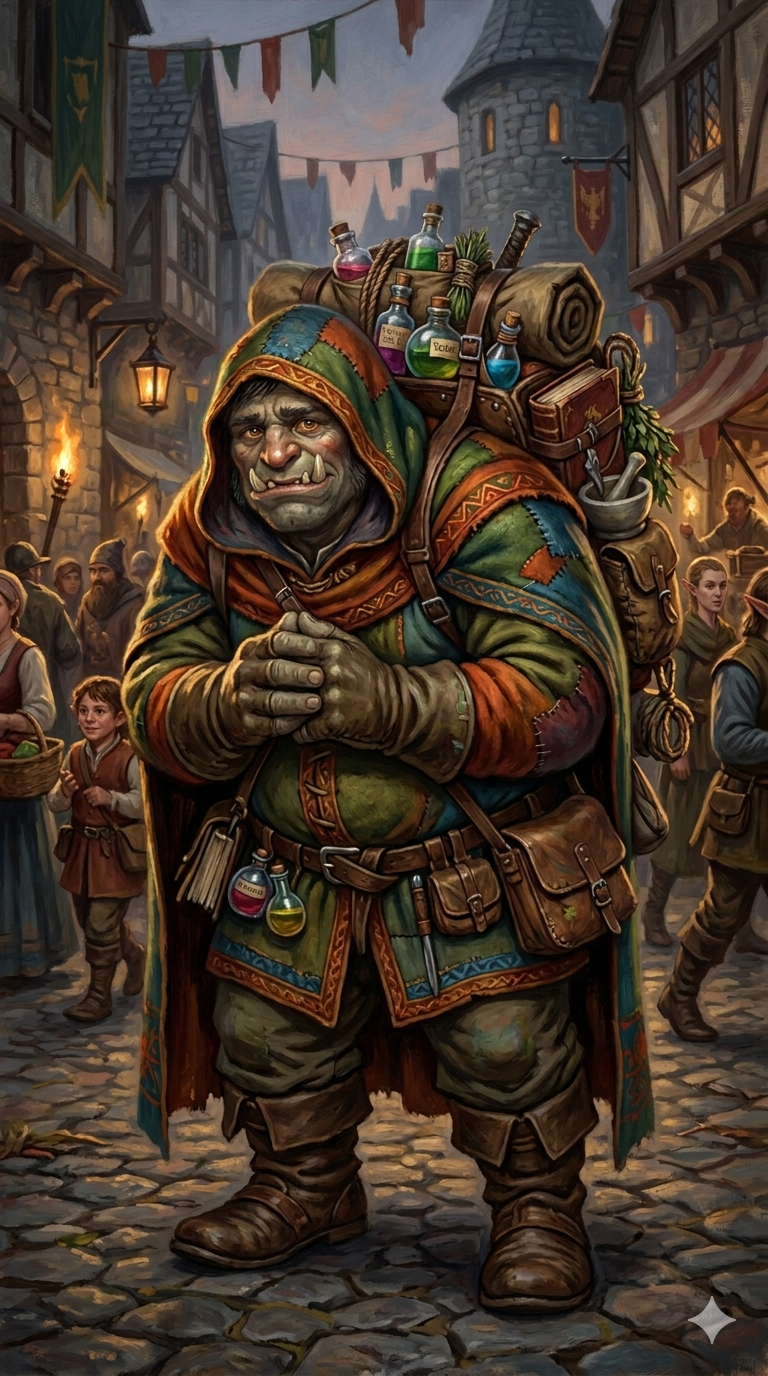
Based on Free League Publishing’s Dragonbane.
Continued from Vulwyn Greenseeker.
Vulwyn Greenseeker left Outskirt before dawn, when the mist lay low over the fields and the town still pretended to sleep.
He did not go by the road. Roads were for those who did not mind being seen, and Vulwyn had lately learned how heavy a gaze could be. So he passed beneath the dripping eaves of the forest, his cloak dark with dew, his satchel heavy against his hip, and the skull of Bryagh the Destroyer wrapped in oilcloth beneath his arm.
Behind him, Outskirt faded into grey. Its roofs vanished first, then its palisade, then the thin spear of smoke rising from the smithy where Okald would soon be stoking the morning fires.
He had said farewell to her the night before.
Not dramatically. Vulwyn had never had much talent for tragedy, and Okald had no patience for it. She had stood with arms folded, broad hands blackened by her trade, her beard braided in two tight cords, and told him what he already knew.
“They fear you now.”
He had smiled, because smiling was easier.
“They have feared many things this past year,” Vulwyn remarked casually.
“Not like this.”
That had ended the matter.
Vulwyn had faced monsters, undead, dragons, and even the champion of Sathmog. He had stood beside heroic companions while Um-Durman itself was raised against the darkness. He had helped bring down Azrahel Koth, whose shadow had lain across the Misty Vale like a curse for generations.
And yet the thing that drove him from Outskirt was not demon fire or dragon wrath, but ignorant disapproval.
Conversations stopping when he entered a room. Mothers drawing children close. Old allies avoiding his eyes. It had started some time ago, and it had only gotten worse.
He could not blame them. That was the worst of it.
The forest opened before him in dripping green corridors. Birds sang somewhere above, brave and foolish and alive. Vulwyn paused beneath a bent pine, lifted his face to the pale morning, and tried to breathe as he once had—lightly, without burden.
He loved the world still. That was what he told himself.
He loved the moss on stone, the silver flash of fish in dark water, the resin-sweet smell of cut pine. He loved laughter, strong drink, pretty songs badly sung, and the stubborn miracle of flowers growing in ruined places.
Yet in his satchel lay grave-dust, black candles, and cursed grimoires full of forbidden knowledge. Beneath his arm rested the skull of a dragon murdered, enslaved, and denied the peace of death.
Vulwyn touched the wrapped bone with one long finger.
“Needs must,” he murmured.
The forest gave no answer.
By sunset he had reached a clearing where old stones protruded from the earth like the teeth of some buried giant. It was a deserted place avoided by hunters, which suited him well.
Vulwyn set Bryagh’s skull upon a flat stone and unwrapped it.
The dragon’s skull was vast even in death, its long jaws curved in a permanent snarl, its empty sockets deep as wells. Vulwyn regarded it with admiration, pity, and hunger.
“Forgive me,” he said, and began.
He drew signs in ash and powdered bone. He set candles in a circle, each flame burning blue despite the damp. He whispered words no animist should have known and listened as the clearing’s living sounds retreated. Crickets stilled. Leaves ceased their rustling.
When the last syllable left his tongue, a cold light kindled in the dragon’s sockets.
The skull spoke without a voice.
Ask.
Vulwyn’s heart quickened.
He asked of The Lunarion, the ancient dragon of who had cursed the beetle-kin of Underhold and doomed their kind to a slow extinction. He asked where the being might be found. He asked whether the curse could be broken.
The answers came like stones dropped into deep water.
The Lunarion’s lair lay in Underhold, beneath the Arena of Titans.
The Lunarion lived.
The Lunarion could be bargained with.
At that, Vulwyn leaned forward, eyes bright.
“Then a pact is possible?”
The skull’s light flickered.
All pacts are possible. That is why mortals should fear them.
Vulwyn smiled despite himself. A lesser man might have stopped there. A wiser one certainly would have.
Vulwyn tried to ask another question.
The candles guttered. Somewhere beyond the ring of stones, branches cracked under a sudden, violent weight.
Vulwyn turned.
The trees exploded toward him.
A young spruce toppled with a shriek of torn roots, and through the wreckage came a shape large enough to make the clearing seem suddenly small. It was an ogre, immense and terrible, with shoulders like boulders and hands that could have crushed a helm flat. Mud streaked his rough skin. Twigs tangled in his hair. His tusked mouth hung open in horror.
For one brief, honest moment, Vulwyn was afraid.
The ogre’s gaze fixed on the skull, the candles, the blackened signs.
“What have you done?” he asked in horror.
Vulwyn lifted both hands slowly. “Peace! This is not how it appears!”
The ogre stomped forward, each step shaking the ground. His fists clenched. His face twisted in rage, and beneath that rage was pain, raw and bewildered.
“Dead things should rest,” the ogre said. “Bones feed soil. Soil feeds roots. Roots feed flowers. Flowers feed bees. This—” His huge hand trembled as he pointed to the skull. “This is wrong.”
The blue flames bent away from him, as if afraid.
Vulwyn glanced at Bryagh’s skull. The light within its sockets dimmed.
“I do not disagree,” Vulwyn said.
The ogre stopped. That answer had not been expected.
Vulwyn let his hands fall. “I am Vulwyn Greenseeker.”
“I am Hugre,” said the ogre, still breathing hard. “And I should smash that skull.”
“Maybe,” said Vulwyn. “It would be dramatic. Messy, but dramatic.”
Hugre’s nostrils flared. His gaze moved from the skull to Vulwyn’s face. The rage did not vanish, but it faltered.
“You jest?”
“Often. Though not always wisely.”
The ogre looked at the circle again. His fists tightened. For a moment Vulwyn saw the struggle pass through him like a storm through trees. Hugre wanted to destroy the thing before him. He wanted to end the foulness, silence the dead dragon, scatter the ashes, and be clean of it.
Instead, slowly, painfully, he unclenched his fists.
“Explain,” he said.
So Vulwyn did.
Not everything. No life could be poured whole into one telling. But he spoke of Outskirt, of adventures, of Um-Durman and the campaign against Sathmog’s champion. He spoke of choices made in fear and curiosity, of doors opened because no other doors remained, and of powers that had clung to him long after necessity had passed.
He spoke of the beetle-kin of Underhold and the curse laid upon them by The Lunarion.
“It is not their bodies that fail,” Vulwyn said quietly. “It is their children. Beetle-kin infants are born alive, but empty-minded. They never learn to speak or think as others do.” His expression darkened. “Their people are slowly dying.”
At that, Hugre’s anger changed shape. The ogre lowered himself carefully onto a fallen trunk, which groaned beneath him.
“That is monstrous,” he said softly.
“So I thought,” Vulwyn nodded.
“And you woke this dead dragon to help them?” Hugre looked confused.
“To learn how to break the curse.”
Hugre frowned, a deep furrow cutting across his heavy brow. “A bad thing for a good reason.”
Vulwyn laughed softly. “That may be my epitaph.”
The clearing grew quieter. Vulwyn dismissed the worst of the circle with a few muttered words. The blue candles went out one by one. Warmth returned by degrees.
Hugre produced a bundle of herbs from a pouch at his belt and, after a moment’s hesitation, offered some to Vulwyn.
“For the smell,” he said.
Vulwyn sniffed the leaves. “Sweetmoss and fennelroot?”
Hugre’s expression brightened despite himself. “You know plants?”
“I was an animist before I became a scandal.”
Hugre considered that. “I am an alchemist. A poor one, sometimes. A better gatherer than seller. People do not like buying healing draughts from someone they think may eat them.”
“I imagine that complicates trade.”
“It does.”
They sat for a time beneath the leaning stones while the mist thinned around them. Vulwyn kindled a small, ordinary fire, with ordinary sparks and ordinary smoke, and Hugre watched closely to ensure no corpses were involved.
Their talk did not linger on darkness. Hugre spoke briefly of the adventurers who had raised him after his mother’s death, of their kindness, and of the day they could no longer keep a growing ogre among frightened innkeepers and suspicious guards.
After leaving them, Hugre had found his way to the southern wetlands. There he found an unexpected peace among the lizard and frog people, who were less concerned with appearances. He even spoke fondly of a roguish frog-man who had kindled in him a fascination with poisons and taught him to cheat outrageously at cards.
Vulwyn listened without jesting.
In turn, Vulwyn spoke of Okald and of the peculiar sorrow of becoming a stranger in a place one had helped save.
Hugre poked at the fire with a stick the size of a spear.
“People see me and think me a monster,” he said.
“People think the same of me now too,” Vulwyn replied.
Hugre looked at him. “Are they wrong?”
Vulwyn opened his mouth, then closed it.
The ogre nodded, as though this honesty pleased him more than any denial could have.
After that, they spoke of gentler things: mooncap mushrooms, marsh-thistle poultices, the right season to cut willow bark, and whether a fox could be trusted to lead a lost traveler. Hugre believed it could, provided the traveler was polite. Vulwyn argued that foxes respected cleverness more than manners.
For the first time in days, Vulwyn laughed without hearing bitterness in it. Yet dawn approached, and with it the matter neither of them could avoid.
Underhold lay far from that clearing, beneath stone and memory. Vulwyn had friends there, or had once. Dwarves with hard hands and harder loyalties. Beetle-kin whose doom had stirred his restless heart.
“I meant to go back,” Vulwyn said at last. “After learning what I could. I meant to face The Lunarion, if fate allowed it.”
“But?”
Vulwyn looked toward the east, where the sky had begun to pale.
“But I have seen how men look at me now. Dwarves will be no kinder. If I come to them bearing dragon bones and necromancer’s marks, speaking of bargains with ancient powers…” He shook his head. “I fear I would bring suspicion where trust is needed.”
Hugre was silent.
Vulwyn expected a rebuke. Instead, the ogre asked, “Do you want to save them?”
“Yes.”
“Then tell me how.”
Vulwyn turned.
Hugre’s broad face was solemn, almost frightened, but there was resolve beneath the fear.
“I can go,” Hugre said. “I know little of dwarves and less of beetle-kin, but I know sickness when I hear of it. I know curses are wounds, even if I cannot brew a draught for them. If there is a path toward healing, I would walk it.”
“You?” Vulwyn said, then regretted the surprise at once.
Hugre gave a sad little smile. “Yes. Me. The ogre. The frightening one.”
Vulwyn bowed his head. “Forgive me.”
“There is nothing to forgive. You saw what everyone sees first.”
“But I should know better,” Vulwyn said.
Hugre’s offer should have troubled Vulwyn. It should have pricked his pride, sharpened his guilt, stirred some heroic refusal. Instead, relief washed through him so swiftly that he nearly laughed.
The beetle-kin would not be abandoned.
The burden would not be dropped. It would be carried by hands larger and gentler than his own.
Vulwyn reached into his satchel and withdrew a hematite medal, several notes, and a handful of vials.
“Then you will need these,” he said.
Hugre accepted them curiously.
“And the skull?” the ogre asked warily.
Vulwyn glanced at Bryagh. The dragon’s empty sockets were dark now.
“I will keep it,” Vulwyn said. “There are questions yet unanswered, and I am not ready to pretend I no longer wish to ask them.”
Hugre’s brow furrowed. “That is dangerous.”
“Yes.”
“For you most of all.”
Vulwyn smiled faintly. “I know.”
The sun broke over the trees in a thin wash of gold. Birds resumed their songs as if the night’s dread had been no more than a passing dream.
Vulwyn wrapped Bryagh’s skull once more. He fastened his cloak, shouldered his satchel, and looked toward the deep wilds where no road promised welcome or return.
“What will you seek?” Hugre asked.
“Balance,” Vulwyn said.
Then he laughed softly.
“And perhaps someone willing to explain what that word means.”
Hugre stood, towering above him, terrible in shape and tender in expression. “I hope you find it, Vulwyn Greenseeker.”
“And I hope Outskirt has very strong doorframes.”
The ogre blinked, then chuckled. It was a low, rumbling sound, like distant thunder trying not to wake anyone.
They parted at the edge of the clearing.
Vulwyn went North, beneath ancient branches, carrying bones, questions, and the faint hope that curiosity need not always lead downward into shadow.
Hugre went South. By midday, the roofs of Outskirt came into view beyond the mist. Smoke rose from chimneys. Hammers rang. Dogs barked, then fell suddenly silent as the ogre approached the gate.
A guard shouted. Another dropped his spear. Somewhere nearby, a child screamed, though whether in terror or excitement Hugre could not tell.
He stopped at once and raised both hands.
“Hello,” he called, trying to sound small and failing completely. “I am Hugre. I do not want trouble.”
The guards stared.
Hugre thought of the notes in his backpack, the doomed beetle-kin beneath the earth, and the strange elf who had looked like a villain while trying, in his crooked way, to do mercy.
“You can talk?” one of the guards asked in disbelief.
Hugre chuckled. “Yes, I can talk.”
Then he remembered the bundle of herbs at his belt.
“I can make healing salves too,” he added hopefully. “And tea.”
For a long moment, no one moved. The guards exchanged incredulous looks before lowering their weapons.
“Uh…” a guard began hesitantly, then cleared his throat. “Welcome… uh… Welcome to Outskirt, I guess.”
Leave a Reply